Compressing a Real-Time Object Detector
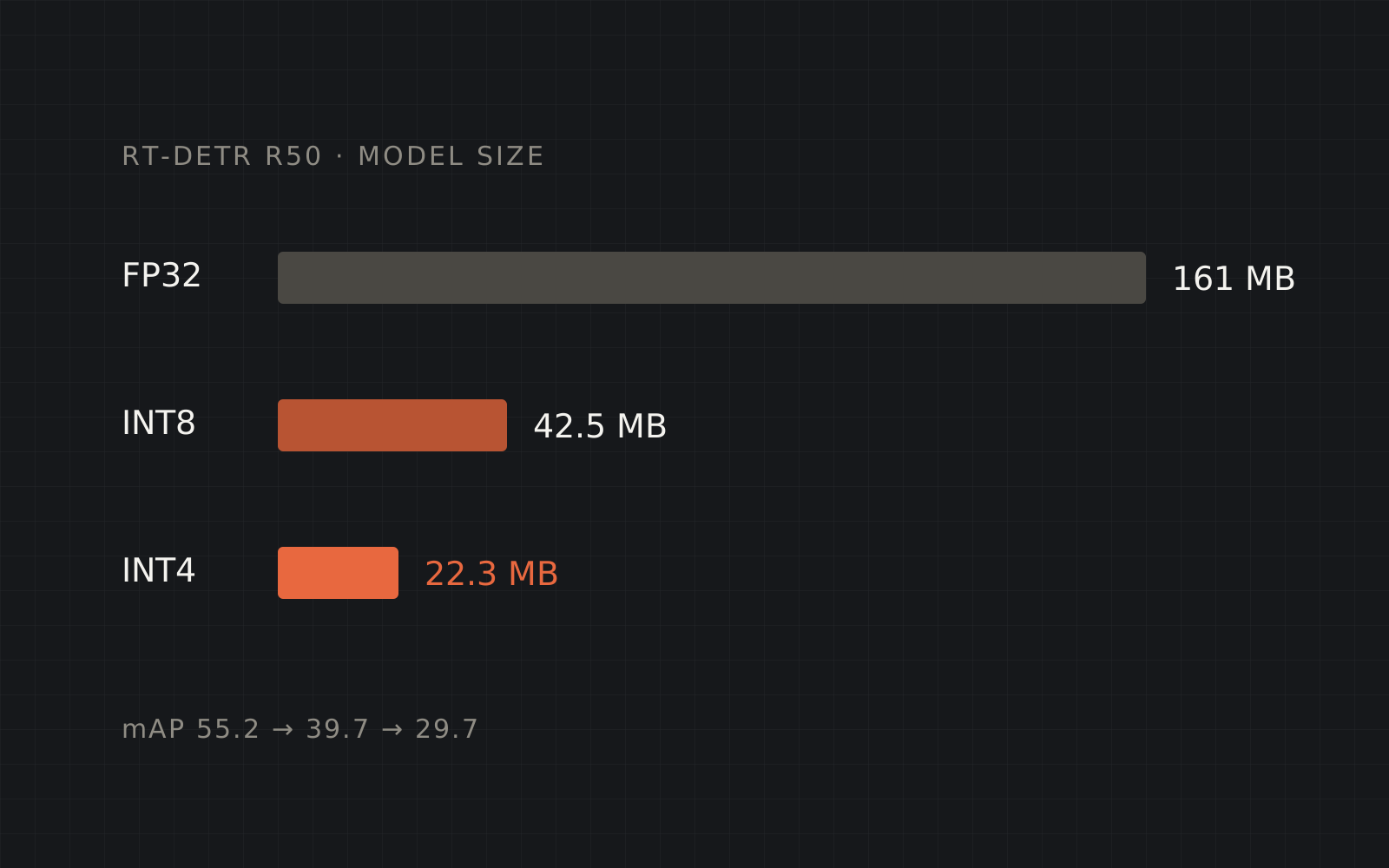
Shrinking an RT-DETR object detection model to run on edge devices. A team project; scope covered the baseline and full-model quantization, taking it from 161 MB to 22 MB.
Shrinking an RT-DETR object detection model to run on edge devices. A team project; scope covered the baseline and full-model quantization, taking it from 161 MB to 22 MB.
RT-DETR R50 detects objects in real time, but at 161 MB in full precision it is too heavy for the small devices it would need to run on. This project measures what happens when the trained model is quantised to lower precision (post-training quantization): how much smaller it gets, how much memory it saves, and how much accuracy it gives up.
This is a team project. The scope below is the part handled here.
| Precision | Model size | mAP | GPU memory |
|---|---|---|---|
| FP32 | 161 MB | 55.2 | 638 MiB |
| INT8 | 42.5 MB | 39.7 | 380 MiB |
| INT4 | 22.3 MB | 29.7 | 380 MiB |
Thinking about building something similar?
Start a Conversation →